


Face to face with food insecurity: Our first-hand account of helping Second Harvest
Over the past two years, dedicated First National volunteers in Vancouver, Calgary, Toronto, Montreal and Halifax have donated their time, talent and muscles to sort and pack over 40,000 pounds of vegetables and more than 11,000 food bags to feed Canadians who are food insecure. Today, that is an alarming one in four people.
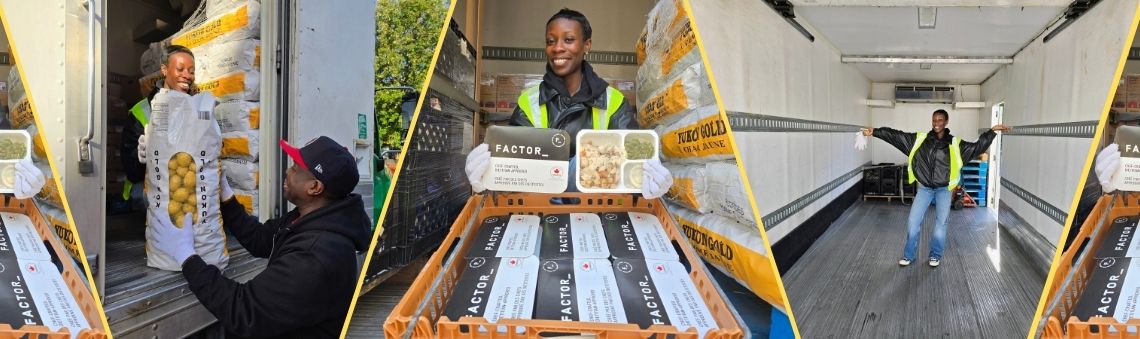
But where does that rescued food go and how does it get there? Four members of our Toronto team – Conor Walsh, Linda Craenen, Adwoa Essumang and Maria Broekhof – found out by participating in Second Harvest delivery truck “ride alongs” to experience the direct impact of Second Harvest’s efforts in serving the city’s most vulnerable communities. These are their stories.
The starting point
For Second Harvest, the day starts early as trucks are packed with nutritious surplus food. Each driver has an assigned route, each route has defined stops and each stop, be it a food bank, church or community centre, requires different quantities and types of food.
Conor got to Second Harvest’s warehouse in time to participate in a morning ritual: a stretching session and pep rally for the drivers and coordinators. After being introduced, Conor was assigned to his driver. “Santiago walked me through the route we would take on the southeast side of downtown. I live downtown so I know it well, but when we got on the road, it was eye-opening to see the need in my own community.”
Conor’s stops along the way included St. Ann’s Parish foodbank started by a parishioner but now serving hundreds of people every month; the pay-what-you-can Moss Park Market, located in an area that is said to have a poverty rate of 30%; and, Friend’s of Ruby, a safe space for 2SLGBTQIA+ youth.
First National has partnered with Friends of Ruby via clothing donations and food drives but to Conor, this hands-on experience was different as it brought home the importance of support “to ensure young people have a warm meal after facing hardship and ostracization.”
“What struck me at that stop was the popularity of quick-made frozen dinners,” said Conor. “They are popular with the kids because they can be prepared on a hot plate or with a kettle. It’s incredible to me that Second Harvest understands what works for the individuals served by food banks and shelters and is able to help those in need with a variety of nutritious food fit for the occasion.”
The last mile
Adwoa was originally unaware of Second Harvest before she volunteered for a food sort with her First National colleagues. Seeing the last mile of distribution, accompanied by Hector, her driver for the day, brought home the vital nature of the food rescue effort.
“I will never forget Hector. When I got in the truck, he presented me with a binder filled with stories and pictures of every stop he made along his route over something like 10 years. While I looked through the binder, Hector answered my questions and it really helped me to better appreciate the experience I was about to have and the impact we would make. Hector was such a caring man; he knew everyone’s name at every shelter and food bank we visited.”
Hector made nine stops that day and by the end, the truck was empty and Adwoa was exhausted, physically and emotionally. Adowa admits to being scared when the driver temporarily left the truck in one location, but gamely participated in the unloading effort when he returned.
“We visited an area near Kensington Market, and it was obvious there was a lot of drug use and a lot of homelessness,” said Adwoa. “There was also a real need for food with a line up outside the foodbank. Everybody was served. Second Harvest knew exactly which facilities needed what, and delivered."
Full circle
For Linda, the ride-along experience brought her volunteer work full circle. “In Vancouver, the Second Harvest location is just up the hill from a foodbank, so our First National volunteers bring the snack packs they prep right to where they are consumed. That’s not the case in Toronto so my ride along gave me the same opportunity to see the value and importance of our food sorting and packing efforts at the other end of the line.”
To Linda, it was a visceral experience, particularly since the trip took her into her own neighbourhood, and demonstrated the kind and caring nature of everyone in the surplus food supply chain. “I’ve heard my colleagues say the same thing. This experience changed my view of who makes up the working poor. It’s not necessarily who you might think.”
Linda was impressed with the effort made to ensure the recipients of food donations felt that their dignity was respected. “For people who have been victimized, shelters are a refuge and Second Harvest is a lifeline,” said Linda. “Until I participated in delivering food, I didn’t know there was a women’s shelter in my neighbourhood, which makes it a very safe space for those who face domestic abuse. But it also reminded me of the widespread nature of need right in our own communities and the importance of working collectively to help in a very direct way.”
Face to face with food insecurity
Maria’s trip also took her face to face with food insecurity in her own neighbourhood.
“I asked one food bank to give me a tour of their facility, and they explained how their mandate is to help families,” said Maria. “Another shelter we visited cares for seniors living alone. A third was a Native Canadian centre. What struck me was that the food we distributed was exactly what each recipient needed. They had food packages for families of four, packages for families of five and Factor Meals for seniors. It was incredibly thoughtful and culturally sensitive.”
Maria was taken with the high quality of the food delivered. “Rescued food may not sound appetizing, but it is absolutely fresh, no spoilage. I encourage everyone to learn about best- before dates because Canadians throw out so much perfectly good food based on that concept. We are something like number three in the world for food waste. Second Harvest’s redirection of surplus food to those in need really is a brilliant use of resources that also cuts down on the production of greenhouse gas.”
It's in our nature
Caring for others comes naturally for the people of First National, on the job and in the communities where we live. That’s why we call our giving program First National Cares.
We thank Second Harvest for giving our teams across the country the chance to make a difference. We look forward to showing more of what’s in our nature in 2026 in partnership with this vital organization.
Related stories:

Careers
Ongoing growth. Confident ambition. Collaborative excellence. Continuous learning. Find your place, purpose and people while building a fulfilling career at First National.