


Raising the bar for social-impact rental housing in Canada
- Project spotlight
- Aug 26, 2026
- Jeremie Leblanc, Assistant Vice President, Commercial Mortgages
How Rooted combined accessibility, affordability, sustainability and smart financing to create a more inclusive model for purpose-built rental housing

Project stakeholders marking project’s grand opening (L-R): Councillor Trish Purdy, JP Collins, former Rooted Chair; Honourable Colton Leblanc, Honourable Leah Martin, Carrie Chiasson, Rooted - Director of Operations & Programs; Dylan Ward, Rooted Director of Real Estate Development; Honourable Barbara Adams
CMHC’s MLI Select program rewards multi-unit housing projects that commit to affordability, accessibility and climate metrics, making it an important driver of social and sustainable outcomes in new purpose-built rental housing across Canada. For our client, Rooted, a non-profit rental housing developer in Nova Scotia, those priorities were already central to the organization’s mission: to deliver long-term affordable housing that is dignified, flexible and inclusive.
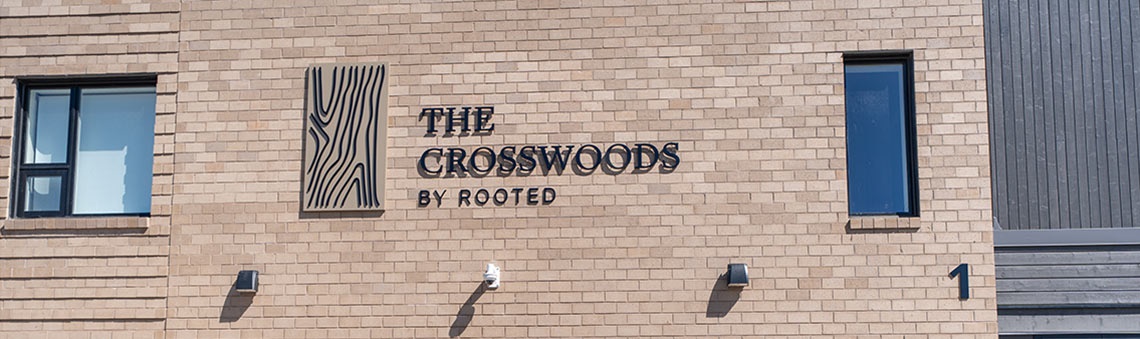
With their latest completed development, The Crosswoods, an 18-unit purpose-built rental building with nine market-rent units and nine affordable units, those social outcomes were not pursued simply to satisfy financing requirements. They became a way to set new internal benchmarks and create a reference point for their future projects.
Designing for accessibility from the start
The Crosswoods was initially conceived to be a flagship project for Rooted: Atlantic Canada’s first hybrid mass timber multi-residential project, combining ambitious sustainability goals with a high standard for accessibility. As with many non-profit housing developers, social outcomes are core to the business, but accessibility is not always executed as comprehensively as it could be. Here, what stood out was how the project integrated the highest Rick Hansen accessibility standards into the earliest stages of planning and design.
At the start, Rooted engaged Kristen Habermehl, a Rick Hansen Foundation Accessibility Consultant and Educator with Atlantic Accessibility Consulting. That timing was critical. By bringing an accessibility lens into the design process before construction drawings were finalized, the development and financing teams could make decisions that were both meaningful and cost-effective. This helped ensured accessibility elements, such as wider bedroom doorways, lower counters with roll-under access, threshold-free showers, accessible controls and hardware, appropriate signage and stronger colour contrast were baked into the design and feasibility. These may sound like small technical details, but they are the difference between a unit that looks compliant and a home that is truly livable for people with accessibility needs.
Rooted also looked at the whole-building experience, considering the site’s relationship to transit, schools, community services and shopping; shared outdoor amenities; paths from parking and sidewalks; entrances; mailbox placement; hallway lighting; and the ability to visit neighbours in other units. This was important, because when shared spaces and non-accessible units are designed so people using mobility devices can enter and move through key areas, residents are not isolated from the life of the building; they can visit friends and participate in the community.
Cost-effectiveness of early planning
Because The Crosswoods was already positioned to earn strong MLI Select incentives through affordability and climate compatibility, Rooted did not need to pursue accessibility as a financing strategy. They chose to follow a high Rick Hansen Foundation accessibility criterion as part of its own standard-setting and the benefits were clear. When accessibility is planned upfront, it has minimal cost impact, adding approximately 1% to total building costs, while dramatically improving usability compared with minimum code expectations. Making the same changes after construction begins, or after completion, can multiply costs and make accessibility improvements far less likely.
The Crosswoods also shows how early financial planning can help social-purpose projects move forward efficiently. Partners included Efficiency Nova Scotia, the Federation of Canadian Municipalities, the Government of Nova Scotia and Halifax Regional Municipality. First National Financial provided long term financing and advisory around available sources of capital as program availability and project needs evolved.

Rooted’s high standards of accessible design was a big draw for local residents Philomena and Sandy
The demand for accessible homes is hard to ignore
Now that the project is complete, the accessible units are fully leased, and demand continues to exceed supply. That reality points to a larger sector challenge: accessible affordable housing remains rare.
Rooted worked through local accessibility networks and advocacy connections to reach prospective residents. That approach helped lease the accessible homes, but it also exposed a gap: the lack of a centralized, reliable system for matching accessible units with households whose needs align with those features. The Crosswoods highlights both the promise of better design and the need for better systems around it.
Shaping what comes next
The Crosswoods serves as a strong example of how accessible housing does not have to be prohibitively expensive when it is integrated early, in the same way affordability and sustainability are addressed at the onset of planning and design.
For Rooted, this experience is already shaping what comes next: a larger development with more than 100 units, again with early accessibility involvement and a continued commitment to modern methods of construction. The goal is not simply to repeat The Crosswoods, but to scale the lessons: engage the right experts early, use financing tools strategically, and design for long-term livability and sustainability.
According to Habermehl, what distinguishes Rooted is its consistent commitment to innovate and find solutions for accessibility rather than question why accessibility is needed. From my point of view, Rooted’s approach to social impact is both sincere and pragmatic, balancing high-quality, innovative work with funding and practical constraints. That attitude may be their most important legacy yet.
About Jeremie LeBlanc
Assistant Vice President, Commercial Financing
Jeremie joined First National Financial in 2022, bringing extensive experience across mortgage lending and multifamily housing finance and development. Before joining First National, he held progressive roles at CMHC spanning residential mortgage underwriting, business development, research and direct lending.
Based in Halifax, Jeremie works with multifamily developers and community builders to structure solutions that advance both project objectives and long-term value, applying his deep knowledge of CMHC programs, policy requirements, risk considerations and approval processes to support efficient execution.
Jeremie also brings deep experience with affordable housing projects, working with cooperative housing providers, not-for-profits, community housing organizations, as well as private-sector landlords and developers. He can be reached at Jeremie.Leblanc@firstnational.ca