


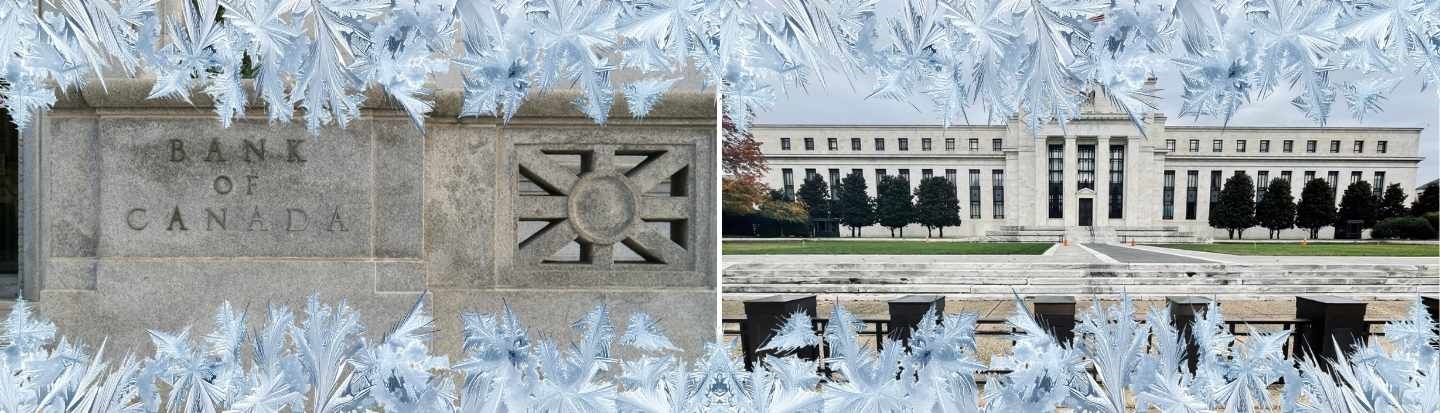
On the Radar: Both Central Banks Are Frozen. What Does That Mean for Canadian Mortgage Rates?
- Economic insights
- Mar 20, 2026
- First National Financial LP
Quick Takes:
- Canadian headline inflation fell to 1.8% in February, below both the 2% target and the 1.9% consensus, but the reading is backward-looking and does not capture the oil shock that began in late February.
- The Bank of Canada held its policy rate at 2.25% for a third consecutive meeting, with Governor Macklem striking a dovish tone on growth while warning that persistent energy prices would force the Bank to act.
- The U.S. Federal Reserve also held, at 3.50–3.75%, projecting only one cut this year while revising its inflation forecast higher to 2.7%, which keeps a floor under Canadian bond yields.
- With Brent crude surging toward US$110, both central banks are trapped between weakening growth and rising energy costs, which means Canadian mortgage rates are unlikely to move lower in the near term.
This was a week where the data said one thing and the world said another. On Monday, Statistics Canada reported headline inflation fell to 1.8 percent in February. That was comfortably below the Bank of Canada’s 2 percent target and below the 1.9 percent consensus.
By any normal measure, that number would have cleared the path for rate cuts. But normal has not applied since late February, when the U.S.–Israeli military campaign against Iran escalated into a near-total closure of the Strait of Hormuz. As a result, Brent crude surged from the mid-US$60s past US$100 and was approaching US$110 by midweek.
Then on Wednesday, both the Bank of Canada and the Federal Reserve held rates steady. Both used almost identical language: uncertainty is acute, the range of outcomes has widened, and it is too soon to know how bad this gets. For Canadian mortgage holders, the meaning is clear: rates are going nowhere soon.
The Inflation Picture Going Into the War
The February CPI report was, on its face, encouraging. Headline inflation fell to 1.8 percent year over year from 2.3 percent in January, undershooting the consensus among economists polled by Reuters. Part of the decline reflects a base-year effect from the end of the federal government’s temporary sales tax relief in February 2025.
The details were mixed. Gasoline prices fell 14.2 percent year over year, largely because of the carbon tax removal. Shelter costs, the largest component of the CPI basket at roughly 29 percent, rose just 1.5 percent as mortgage interest costs eased.
Rent, however, climbed 3.9 percent. Food remained a pressure point, with grocery prices up 4.1 percent and restaurant prices up 7.8 percent. Statistics Canada noted that food prices have risen 30 percent over five years.
The Bank of Canada’s preferred core measures told a calmer story. Both CPI-median and CPI-trim came in at 2.3 percent, near the middle of the 1–3 percent control range. That suggests underlying price pressures remain well contained.
Bond markets liked the number. Two-year Government of Canada yields fell on the release, and the Canadian dollar firmed slightly.
But February’s data are a rearview mirror. They capture prices before the Hormuz closure and before Brent broke US$100.
March’s inflation print, due April 20, will be the first to reflect the energy shock. It will almost certainly be higher. The real question is how long that shock lasts and how deep it runs.
The Bank of Canada: Dovish on Growth, Conditional on Inflation
The Bank of Canada held its overnight rate at 2.25 percent on Wednesday, March 18. This was the third consecutive hold since the October cut. The decision was unanimous and widely expected, but what mattered was the commentary.
Governor Macklem painted a growth picture that has deteriorated since January. Employment gains from the fourth quarter of 2025 have been “largely reversed,” and the unemployment rate rose to 6.7 percent in February. First-quarter growth is now expected to come in below the Bank’s 1.8 percent annualized forecast.
Macklem said risks to growth are “tilted to the downside.” He described the U.S.-led review of the North American trade treaty as a “big unknown” for an economy that sends roughly 20 percent of its GDP across the border.
On inflation, Macklem drew a clear line. The Bank will “look through the war’s immediate impact” on CPI, which he acknowledged would push prices higher starting in March.
But he added a condition that mortgage holders should watch closely. “If energy prices stay high, we will not let their effects broaden and become persistent inflation,” he said. “The longer this conflict lasts and the wider it gets, the bigger the risks.”
That statement matters because it reveals the Bank’s default position. It plans to treat the oil spike as temporary and keep the door open to easing. However, if energy costs feed into broader prices, the Bank will tighten instead.
Macklem also noted that financial conditions have already tightened since the war began. Bond yields have risen, equity markets have fallen, and credit spreads have widened. In other words, the market is doing some of the Bank’s work for it.
The overall tone was dovish. Macklem emphasized the deterioration in the growth outlook and played down the immediate risks from higher energy prices. Still, if energy costs stay elevated for months rather than weeks, the Bank’s patience will be tested.
The Federal Reserve: One Cut Left, and Fading
Hours after the Bank of Canada, the Federal Reserve delivered its own hold. It kept the federal funds rate at 3.50 to 3.75 percent by an 11–1 vote. The decision was expected, but the commentary was not as benign as markets had hoped.
The closely watched dot plot still showed a median of one 25 basis point cut by year-end. But Chair Powell acknowledged that “there was actually some meaningful amount of movement, toward fewer cuts by people.” The committee is shifting hawkish.
Officials revised their PCE inflation forecast up to 2.7 percent for 2026, from 2.5 percent in December. The actual core PCE reading had already accelerated to 3.1 percent in January. That is well above the Fed’s 2 percent target, even before the war disrupted energy markets.
Powell was blunt about the difficulty. “The forecast is that we will be making progress on inflation, not as much as we had hoped, but some progress,” he said.
He noted that near-term inflation expectations have risen, “likely reflecting the substantial rise in oil prices caused by the supply disruptions in the Middle East.” He added that “higher energy prices will push up overall inflation,” but that “it is too soon to know the scope and duration of the potential effects.”
Meanwhile, the U.S. labour market added its own complication. The economy lost 92,000 jobs in February, and the unemployment rate edged up to 4.4 percent. That is the same uncomfortable mix the Bank of Canada faces: weakening jobs alongside rising inflation.
What This Means for Canadian Mortgage Rates
The Bank of Canada’s hold at 2.25 percent means prime rate stays where it is. As a result, variable mortgage rates remain unchanged. The dovish tilt in Macklem’s comments suggests the next move is still more likely to be a cut than a hike, but only if core inflation stays anchored.
The earliest the Bank could reasonably cut is April 29, when it publishes its next Monetary Policy Report. Until then, variable-rate holders sit tight.
On the fixed side, the Fed matters most. Fixed mortgage rates in Canada are priced off GoC 5-year and 10-year bond yields, and those yields cannot fall far when U.S. Treasury yields remain elevated. The GoC 10-year yield sat at 3.39 percent on March 17, with the 5-year near 3 percent.
The Fed projects only one cut this year, and officials are moving toward fewer. Because of that, U.S. yields will stay high.
That keeps a floor under Canadian bond yields. In turn, it limits the scope for fixed-rate relief.
The wildcard is oil. Brent crude surging toward US$110 could break the stalemate in either direction.
If the Strait of Hormuz reopens and oil falls back toward the mid-US$70s, the Bank has room to cut. Bond yields would likely follow, creating relief for both variable and fixed mortgage holders.
But if the strait stays closed and crude pushes well above US$100 for months, headline inflation will rise. The Bank may have no choice but to hold or even tighten. Bond markets would then demand a larger inflation risk premium, pushing fixed rates higher.
What Could Change the Picture
Three things to watch. First, the duration of the Hormuz disruption. If tanker traffic resumes within weeks, oil pulls back and both central banks can resume the gradual easing path that the pre-war data supported.
Second, the March CPI print, due April 20. That will be the first reading to capture the oil shock. If headline CPI jumps but core stays near 2.3 percent, the Bank can look through it.
Third, the April 8 labour force survey. If job losses accelerate and unemployment climbs past 7 percent, the growth argument for cutting rates becomes harder to ignore, even with rising headline inflation.
Bottom Line
The data going into this week favoured lower Canadian mortgage rates. Inflation was below target, core pressures were contained, and the labour market was soft enough to justify further easing. But the war in the Middle East has frozen both central banks in place.
The Bank of Canada wants to support a weakening economy but cannot risk letting an energy shock become embedded in broader prices. The Federal Reserve faces the same bind with stickier U.S. inflation. That freeze means the overnight rate stays at 2.25 percent, prime stays put, and variable rates go nowhere.
On the fixed side, a Fed in no hurry to cut keeps U.S. yields elevated. That anchors GoC 5-year and 10-year yields, which form the floor under fixed mortgage rates.
The most likely path is still eventual easing. Both Macklem and Powell signalled that they view the energy shock as temporary. But “temporary” only holds if the conflict does not widen further.
The next six weeks will be decisive. The March CPI print lands April 20, and the Bank’s next decision follows on April 29. Until that picture clears, mortgage rates are stuck.

Sign up for Market updates
Looking for advice and insights on commercial real estate? Sign up today for the Market Update email.
Related Articles
- On the Radar: A Peace Deal Sent Oil Prices Tumbling but the Fed Still Signaled Higher Rates. What Does It Mean for Canadian Mortgage Rates?
- On the Radar: The Bank of Canada Held, U.S. Inflation Hit a Three-Year High, and Trump Threatened the Trade Deal. What Does It All Mean for Mortgage Rates?
- The Bank of Canada keeps its policy interest rate at 2.25%
- What’s up with Canada’s commercial real estate and financing markets?
- On the Radar: The Canadian Yield Curve Normalized After a Two-Year Inversion. What Does That Mean for Choosing Between a Five-Year and Ten-Year Fixed?
- On the Radar: The Bank of Canada Held Rates, but the Real Story Was What It Said About Housing. What Does It Mean for Mortgage Rates?